
Rhythm First Food Next
Rhythm First, Food Next
Why does how you live matter more than what you eat?
In Ayurveda, health is not built from food alone.
It is built from rhythm.
Before we ask “What should I eat?” we are invited to ask something deeper: “Am I living in rhythm?”
Because what sustains life is not just nutrients—it is timing, cycles, and flow.
Ayurvedic Nutrition - Click Here
|
Ayurvedic Nutrition - Click Here |
Life Is Made of Rhythms
What keeps us alive is rhythm.
The breath moves in rhythm.
The heart beats in rhythm.
Digestion follows a rhythm.
Hormones rise and fall in rhythm.
The moment life ends, what stops?
Prana—the movement, the rhythm.
Every living system in nature follows cycles.
If the Earth suddenly stopped spinning, even for a moment, life would be disrupted.
If it snowed in the middle of summer, we would immediately sense that something is wrong.
In the same way, when our internal rhythms are disturbed, the body signals imbalance.
Missing a menstrual cycle is a loss of rhythm
Irregular bowel movements are a loss of rhythm
Staying up late at night is a loss of rhythm
These may seem small, but over time, these micro-disruptions accumulate.
The body is incredibly adaptable—but not indefinitely.

Wellness Is Returning to Rhythm
In Ayurveda, healing is not about control—it is about returning to harmony.
Think of an orchestra.
When every instrument is in rhythm, there is music.
When one instrument goes off, the whole experience changes.
Your body works the same way.
When your daily rhythms are aligned, digestion improves, energy stabilizes, and the mind becomes clear.
When rhythm is lost, even the “perfect diet” cannot restore balance.
This is why in Ayurveda we say:
Rhythm first. Food next.
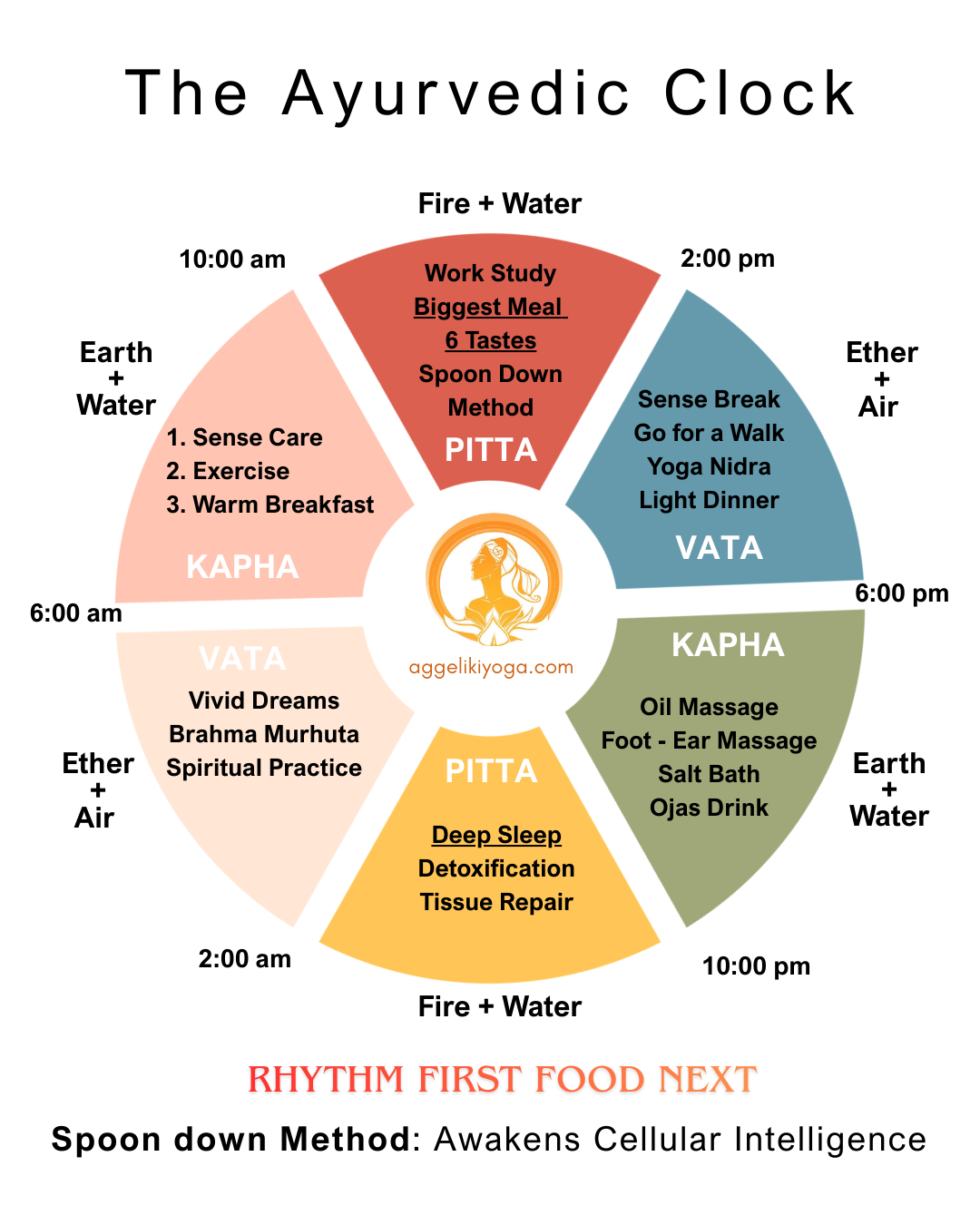
Understanding the Rhythm of the Day
Your body follows a natural circadian rhythm, guided by the qualities of nature throughout the day.
Morning (6–10 AM) — Kapha (Water & Earth)
This is a slower, heavier time.
Cortisol and blood sugar naturally rise to wake you up
Hunger is still low
Digestion is not at its strongest
This is why Ayurveda recommends:
Warm drinks
Light, warm breakfasts
A cold smoothie in the morning may seem healthy—but it can shock the digestive fire (Agni) before it has had a chance to awaken.
Over time, this can lead to:
Low appetite at lunch
Sluggish digestion
A weakened metabolic rhythm
Midday (10 AM–2 PM) — Pitta (Fire)
This is the peak digestive window.
Digestive enzymes are strongest
Insulin sensitivity is higher
Hunger hormones are well-regulated
This is when your body is most prepared to:
digest, absorb, and transform food into energy
👉 Your largest meal should be here.
Afternoon (2–6 PM) — Vata (Air & Ether)
Energy becomes lighter and more variable.
You may notice:
A natural dip in energy
The first yawn of the day
Instead of pushing through, Ayurveda suggests:
A pause
A few conscious breaths
A light herbal tea (like peppermint)

Evening (6–10 PM) — Kapha (Earth & Water)
As the sun sets, the body begins to shift toward rest.
Neurochemically, the body moves from:
Excitatory (active)
→ toInhibitory (calming)
If we align with this:
We feel grounded
Sleep comes naturally
If we resist it (screens, work, stimulation):
Anxiety or restlessness can arise
👉 This is why Ayurveda recommends:
An early, light dinner
Winding down with the body
Night (10 PM–2 AM) — Pitta (Internal Fire)
This is not a time for activity—it is a time for deep internal repair.
The body:
Processes food
Cleanses tissues
Digests emotional and mental experiences
If we are awake during this time, we miss this essential metabolic reset.
Early Morning (2–6 AM) — Vata (Ether & Space)
This is a subtle, quiet, expansive time.
Traditionally:
Meditation
Breathwork
Stillness
They are most supportive here.
Food Without Rhythm Creates Imbalance
You can eat the highest quality foods…
But if they are eaten out of rhythm, the body cannot use them properly.
For example:
Eating late at night → poor digestion
Heavy breakfast when digestion is low → sluggishness
Skipping meals during peak digestion → weakened metabolism
This is why many people say:
“I eat healthy, but I don’t feel well.”
The missing piece is often not the food.
It is the timing.
Start Simple: Build One Day of Rhythm
You don’t need to change everything at once.
In Ayurveda, we begin with:
one day
Then we expand to:
Seasonal rhythms
Hormonal rhythms
Life-stage rhythms
Small, consistent alignment creates lasting change.

An Invitation
If this resonates with you, this is exactly the foundation I teach inside my Ayurvedic Nutrition Classes.
We don’t start with restrictions or complicated rules.
We begin with rhythm—because when rhythm is restored, the body naturally knows what to do.
From there, food becomes intuitive, digestion improves, and balance becomes sustainable.